# Beurteilung der Mikrozirkulation
### Klinische Untersuchung
- die Rekapilarisierungszeit und die Marmorierung könne erste Hinweise geben
- sie sind abhängig von vielen Faktoren wie z.B. Vasopressoren, Inotropika etc.
- die Untersuchung sollte aber als klinischer Verlaufsparameter regelmäßig evaluiert werden
[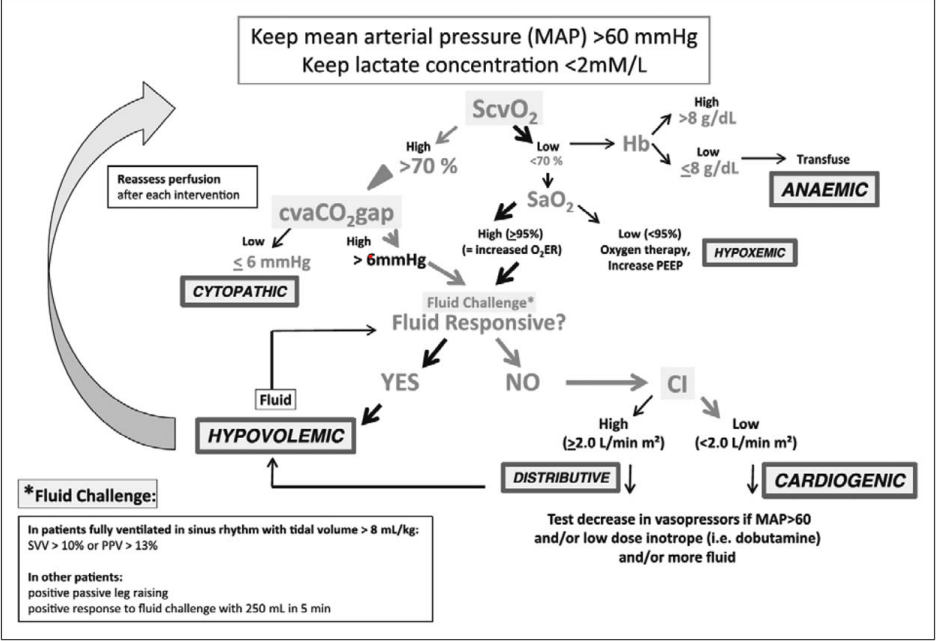](https://bookstack.cloud1610.de/uploads/images/gallery/2025-11/image.png)[1](#bkmrk-footnote-1764360725584 "https://fundanest.org.ar/wp-content/uploads/2016/07/CO2-gaps.pdf")[ ](https://bookstack.cloud1610.de/uploads/images/gallery/2025-11/image.png)
### ScVO2
- von sehr vielen Faktoren abhängig und eine adäquate O2 Versorgung muss gewährleistet sein.
### Pa-vCO2-Gap[2](#bkmrk-footnote-1764360825279 "Vallet B, Pinsky MR, Cecconi M. Resuscitation of patients with septic shock: please "mind the gap"! Intensive Care Med. 2013 Sep;39(9):1653-5. doi: 10.1007/s00134-013-2998-5. Epub 2013 Jun 29. PMID: 23812340; PMCID: PMC3732761.")
- Pa-vCO2 ist ein Surrogat Parameter für das HZW
- Ein Pa-vCO2 > 6 mmHg zeigte möglicherweise einen Schockzustand an der auf Volumen oder Inotropika anspricht.
- Manche Studien konnten eine Korrelation von Pa-vCO2, HZV, ScVO2 und Gewebeperfusion zeigen.[3](#bkmrk-footnote-1764359743736 "Al Duhailib, Zainab MBBS, EDIC1,2,3; Hegazy, Ahmed F. MB BCh, MSc, MPH1,,4; Lalli, Raj MD5; Fiorini, Kyle MD1; Priestap, Fran MSc1; Iansavichene, Alla BSc, MLIS6; Slessarev, Marat MD, MSc1,,7,,8. The Use of Central Venous to Arterial Carbon Dioxide Tension Gap for Outcome Prediction in Critically Ill Patients: A Systematic Review and Meta-Analysis*. Critical Care Medicine 48(12):p 1855-1861, December 2020. | DOI: 10.1097/CCM.0000000000004578 ")
#### Pa-vCO2-Gap in verschiedenen Schockarten
| Schock-Art | Laktat | O2 Extraktion | ScvO2 | Pa-vCO2-Gap |
| kardiogen oder hypovoläm | hoch | hoch | niedrig | hoch |
| anäm oder hypoxisch | hoch | hoch | niedrig | niedrig |
| distributiv | hoch | niedrig | hoch | hoch |
| zytopatisch | hoch | niedrig | hoch | niedrig |
### Pa-vCO2/Ca-vO2
- Möglicherweise könnte der Quotient aus Pa-vCO2/Ca-vO2 als Marker für den anaeroben Metabolismus verwendet werden.
- Diese Marker reagieren im Vergleich zum Laktat recht schnell auf eine Änderung der Situation.